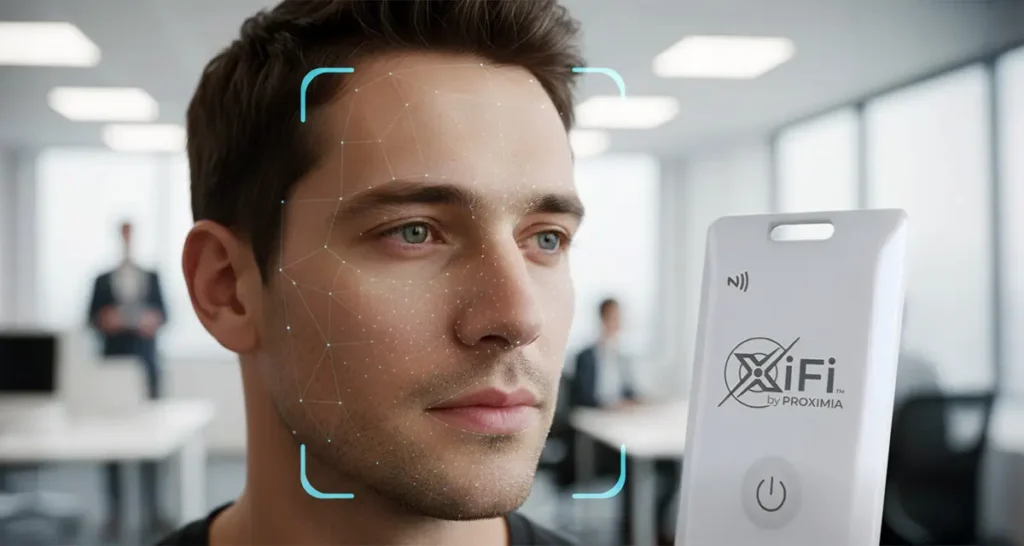

Static sign-in — even with MFA, biometrics, or passwordless methods — proves identity only once, then trusts the session until it times out. Continuous authentication closes that gap: Proximia's XiFi Card maintains real-time presence for as long as the session lasts, locking access the instant the user steps away. The result is stronger security with less friction, well suited to shared workstations, legacy systems, and high-security workspaces.
- Static sign-in — biometric, passwordless, or MFA-protected — verifies identity once and then trusts the session until it ends or times out.
- SpyCloud recaptured 8.6 billion stolen session cookies from criminal marketplaces in 2025, showing how often attackers bypass sign-in entirely and hijack the session that follows it (SpyCloud, 2026 Identity Exposure Report).
- Proximia's XiFi Card replaces that one-time trust with continuous, presence-aware protection, locking the session automatically the moment the user steps away.
- Shared workstations, hospitals, and legacy systems are especially exposed, since anyone who reaches an unlocked, still-authenticated session inherits the previous user's access.
- Continuous authentication also reduces friction: users re-authenticate less often because presence, not repeated prompts, keeps the session secure.
Why Continuous Authentication Outperforms Even the Most Secure Static Sign-Ins
Understanding the differences between continuous authentication vs static sign-in is crucial for enhancing security protocols.
For years, organizations have invested heavily in strengthening the sign-in event. Multi-factor authentication, biometrics, passkeys, FIDO2 keys, and advanced identity-proofing methods have all helped ensure that the right person is the one accessing a system. These advancements are important—but they all share the same foundational limitation, particularly when comparing continuous authentication vs static sign-in.
For example, in regulated industries, where sensitive information is frequently accessed, the implications of static sign-in systems can be severe. A nurse in a hospital might sign in to a system to check patient records and then momentarily leave their workstation. If another individual were to access that session, the privacy of the patient could be compromised, leading to serious legal and ethical consequences.
Static systems stop at the moment of sign-in, while continuous authentication provides ongoing verification.
Once a user is authenticated, most systems assume the session remains safe. But in today’s environment, that assumption is increasingly risky. Threats don’t end at sign-in, and neither should authentication.
The Problem With Static Sign-In Models
 In examining security models, it’s essential to highlight additional scenarios where static sign-in fails. For instance, consider a scenario in a corporate environment where employees share devices:
During shifts, one employee may sign in to access sensitive files, but if they step away without signing out, another employee could take advantage of the open session. This situation exposes the organization to significant risks, making continuous authentication essential in such shared environments.
Even the strongest static sign-in—biometric, passwordless, or cryptographically protected—only verifies identity once. After that, the system places trust in the session until it ends or times out. That creates multiple vulnerabilities:
- Walk-away risk: A user steps away from a workstation, but the system still thinks they’re present.
- Session hijacking: Attackers exploit open sessions, cached tokens, or unattended devices — SpyCloud recorded attackers using stolen session cookies and tokens to "bypass MFA protections, impersonate authenticated users, [and] move laterally across SaaS environments" in its 2026 Identity Exposure Report.
- Shared workstation exposure: In hospitals, manufacturing floors, or government offices, users often rotate devices, making sign-in-only trust insufficient.
- Legacy systems: Many applications can’t enforce modern session integrity, leaving security dependent on that first sign-in action.
No matter how strong the initial authentication is, it cannot protect what happens afterward. Attackers increasingly target session weaknesses, not the sign-in itself.
Why Continuous Authentication Is a Superior Model
Continuous authentication — delivered through Proximia’s XiFi Card — shifts the security model from “trust at sign-in” to “trust as long as the right person is present.”
Instead of assuming the session remains safe, continuous authentication constantly evaluates:
- Is the trusted user still physically present?
- Is the trusted device still in proximity?
- Are both user and device maintaining mutual trust signals?
- Has the environment changed in a way that increases risk?
By integrating real-time checks and balances, organizations utilizing continuous authentication can not only defend against potential threats but also foster a culture of security awareness among their employees. This proactive approach to security is essential in today’s digital landscape, where threats are constantly evolving.
Stronger Security With Less User Friction
The powerful irony is that continuous authentication is not only more secure—it's also more convenient. Users authenticate less often because the system validates their presence naturally. There’s no need to repeatedly enter factors, juggle authenticators, or face constant prompts. Password-related issues alone already drive an estimated 20-50% of help desk tickets, at an average cost of about $70 per reset (Gartner; Forrester) — friction that presence-based, continuous authentication removes almost entirely. Security becomes ambient and automatic.
Static Sign-In Is Yesterday’s Model
In a world of persistent threats, shared devices, hybrid work, and sensitive data flowing across countless systems, securing only the sign-in event is no longer enough.
Continuous authentication delivers what static sign-in can’t: real-time, uninterrupted assurance that the right person remains in control—long after the sign-in screen disappears. This ensures that organizations can maintain a high level of security while adapting to modern working environments, where mobility and flexibility are paramount.