
Passwordless authentication replaces passwords with FIDO2-based passkeys and biometrics, letting users sign in through something they are or have rather than something they must remember and protect. It removes stored credentials as an attack surface while aligning with frameworks such as NIST 800-63B. Paired with continuous, presence-based authentication, it verifies not just who signs in, but who stays present throughout the session.
- Passkeys and biometrics eliminate the passwords attackers most often steal, phish, or guess.
- Attackers recaptured 8.6 billion stolen session cookies in 2025, showing that authentication alone cannot secure a session once it begins (SpyCloud, 2026 Identity Exposure Report).
- Removing shared secrets closes off credential-stuffing and brute-force attacks before they start.
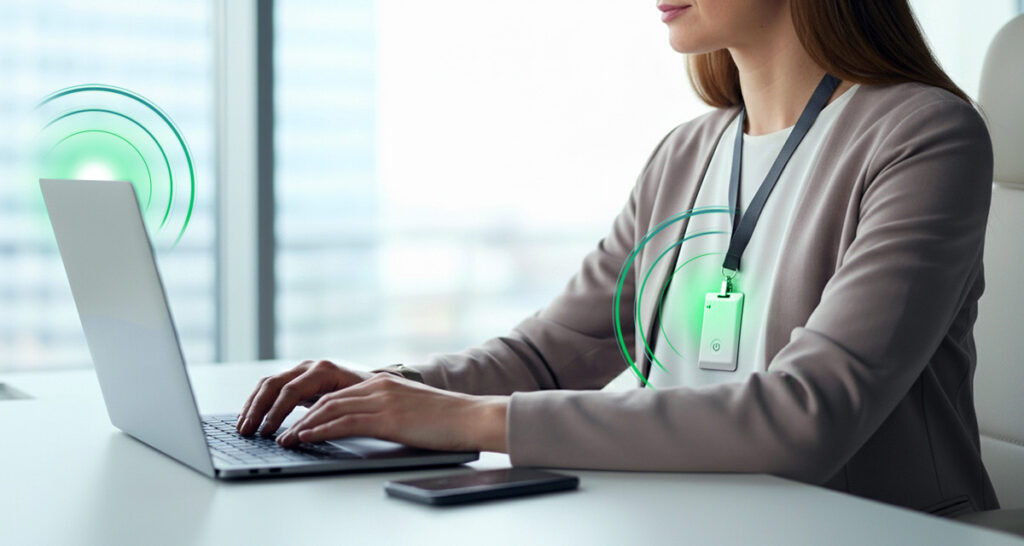
- Proximia's XiFi Card extends passwordless sign-in with continuous, presence-based verification for the life of the session.
What Is Passwordless Authentication?
Passwordless authentication verifies a user’s identity without passwords, using either biometric data, hardware keys, or cryptographic credentials. Instead of memorizing something you know, users prove identity through something they are or have.
How Passwordless Sign-In Works:
- The user's device generates a public–private key pair during enrollment.
- The private key remains secured on the device.
- User initiates sign-in and the service sends a unique, one-time cryptographic challenge.
- The user authenticates to their device using biometrics.
- The device uses the private key to cryptographically sign the challenge.
- The signed challenge response is sent to the service.
- The server validates the public key, granting access without transmitting a password.
This eliminates stolen credential risk and provides faster, frictionless sign-ins.
Why Passwordless Authentication Matters
Eliminate Passwords, Eliminate Risk
- No passwords to steal, reuse, or phish.
- Stops credential stuffing and brute-force attacks.
- Removes password reset requests and IT overhead.
97% of identity attacks exploit password credentials. (Microsoft, 2025)
Better User Experience
Users authenticate instantly via biometrics and trusted devices—no passwords, codes, or prompts. Adoption rises because authentication becomes invisible, not inconvenient.
Zero Trust and Compliance
Passwordless aligns with modern frameworks like FIDO2 and NIST 800-63B, verifying identity cryptographically instead of relying on static secrets. It supports Zero Trust principles, where every access request is continuously verified.

Passkeys and FIDO2 Explained
Passkeys
Passkeys are encrypted digital credentials unique to each account or device.
They:
- Replace passwords with public–private key cryptography.
- Sync securely via iCloud Keychain or Google Password Manager.
- Use biometrics like Face ID or fingerprints for verification.
FIDO2
FIDO2 (Fast Identity Online) is the open standard behind most passwordless systems, developed by the FIDO Alliance and W3C.
It includes:
- WebAuthn API: Enables passwordless sign-in in browsers.
- CTAP Protocol: Connects hardware authenticators (like YubiKeys) to apps.
Together, they standardize secure, interoperable passwordless authentication worldwide.
Security Benefits: Password vs. Passwordless
| Phishing | User can be tricked | No secret to steal |
| Resuse | Common across sites | Device-specific |
| Brute Force | Feasible | Cryptographically impossible |
| Password Resets | Frequent | Eliminated |
| User Experience | Slow, repetitive | Seamless, biometric |
Passwordless authentication doesn’t just strengthen security, it removes the root cause of compromise.
Beyond Security: Operational and User Experience Benefits

Passwordless authentication is not just a security upgrade. It delivers measurable gains across productivity, usability, and cost efficiency.
- Reduced friction and faster access: Users sign in instantly using biometrics or device-based authentication. This shortens sign-in times and removes repeated authentication steps throughout the day.
- Decreased cognitive load: Employees no longer need to create, remember, or reset complex passwords. This reduces frustration and mental overhead, especially in high-pressure environments like healthcare and IT operations.
- Higher user adoption and engagement: When access is simple and reliable, users are more likely to adopt secure workflows instead of bypassing controls. This leads to better compliance without added enforcement.
- Lower operational costs: Password resets are a major driver of helpdesk volume. Eliminating passwords reduces support tickets, lowers IT workload, and cuts associated costs. Gartner estimates that password resets can account for up to 50% of helpdesk calls.
- Simplified account and identity management: Passwordless systems reduce dependency on password policies, rotation schedules, and recovery workflows. This streamlines identity lifecycle management across onboarding, access changes, and offboarding.
Implementation Challenges & Best Practices
Challenges
- Legacy systems without FIDO2 support
- Training and user adoption
- Lost device recovery
- Managing multi-device trust
Best Practices
- Pilot deployments: Start with IT and security teams.
- Use FIDO2-certified hardware: TPM chips, YubiKeys, Secure Enclave.
- Integrate with SSO/IdP
- Plan fallback paths: Layer continuous verification for unsupported apps.
“Passwordless” equals stronger, not weaker, security.
The Future of Passwordless Authentication
Passwordless authentication is the foundation for adaptive identity systems, where:
- Risk is assessed in real time.
- Sessions remain continuously validated.
- Presence and proximity signals supplement cryptographic verification.
As FIDO2 adoption spreads, presence-aware authentication (like Proximia) will define the next stage of passwordless security maturity.

Integrating Proximia’s Presence-Aware Security
While FIDO2 and passkeys eliminate passwords, Proximia enhances this with continuous, presence-based authentication that verifies not just sign-in events, but ongoing user presence.
- Biometric verification: Confirms identity at access.
- Proximity detection: Uses the XiFi Card or phone to verify presence.
- Session intelligence: Locks automatically when users step away.
This creates continuous, frictionless authentication ideal for Zero Trust and modern adaptive security environments.
Frequently Asked Questions
Final Thoughts
Passwordless authentication is more than a security upgrade—it’s a usability revolution.
By eliminating passwords, implementing FIDO2 standards, and layering continuous verification from Proximia, organizations can achieve true Zero Trust without friction.
Ready to eliminate passwords and modernize your security?
See how Proximia integrates passwordless authentication with continuous presence verification.
Schedule a Demo →