
TLDR:
Traditional authentication methods stop verifying once you log in, leaving security gaps whenever tokens are lost, shared, or misused. Proximia replaces point-in-time checks with continuous, presence-aware authentication that verifies who you are, where you are, and that you remain there. By combining biometrics, proximity detection, and persistent session management, Proximia ensures seamless, frictionless security that locks access the moment presence is lost—no passwords, no prompts, no compromises. It’s authentication that doesn’t just start secure, it stays secure.
Proximia redefines authentication by shifting from momentary possession proofs to continuous presence verification by blending physical proximity, biometric checks, and privacy-first design to deliver seamless, secure experiences that traditional tokens simply cannot match.
Redefining Authentication Beyond the Token
For decades, the security industry has relied on tokens—smartcards, RSA fobs, one-time codes, even modern passkeys—to prove that a user “has” something. This token is often granted in trust at the end of a process to confirm the owner's identity and rights to bear the token, such as visual proof of identity or even a background check which happens at a point in time. Once that threshold is crossed, this token is then used in lieu of this identity process (at least for a time) so that it can be presented to gain access to a particular system (usually with something the user knows, such as a pin or password). However, possession has proven to be a fragile stand-in for identity, as these tokens can be lost, stolen, cloned, run out of charge, or forgotten. And once the bearer has cleared a point-in-time authentication check, the tokens offer no guarantee that the authenticated individual remains present or that the token is actually in the hands of its rightful owner.
Proximia moves beyond the limitations of static tokens by adding persistent physical presence as a factor for the credential, which offers a security paradigm that is:
- Continuous: Verification doesn’t end at login.
- Transparent: Authentication happens passively in the background.
- Time-Bound: Credentials auto-expire and auto-refresh based on real-time proximity.
Tokens Are Fragile; Presence Is Resilient
Traditional authentication methods share one inherent weakness: they verify identity only at a single moment in time. Once a user passes the initial authentication hurdle, such as a password, MFA code, or biometric scan, the system grants access and assumes continued legitimacy. This transactional model leaves organizations vulnerable to session takeover attacks, credential compromise after authentication, and unauthorized access during periods when users step away from their devices.
In contrast, Proximia’s combination of continuous biometric verification, proximity detection, and persistent session monitoring ensures that authentication remains tied to the user’s active , verified presence. This model provides ongoing confidence that the authenticated individual is still present and authorized to maintain access.

Possession ≠ Presence
Users frequently leave their workstations unlocked, even with company policies requiring automatic screen locks. A logged-in user stepping away for coffee or a meeting creates a window of vulnerability where a malicious actor could exploit that moment of absence. Point-in-time security fails to answer the question: “Is the right person still here, still authorized, right now?”
Proximia’s approach addresses this gap:
- Biometric Identity Verification: Face recognition via phone camera or workstation webcam confirms who is accessing the system.
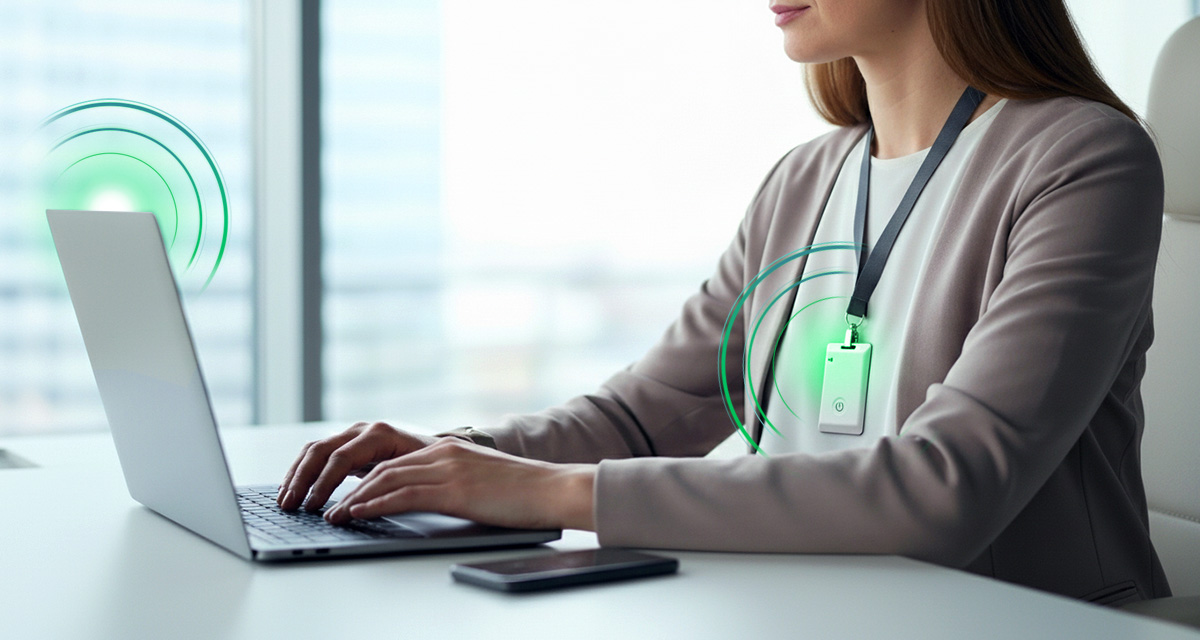
- Proximity-Based Persistence: Real-time proximity detection through wearable devices or smart badges verifies ongoing presence.
- Dynamic Session Management: As long as proximity signals and bi-directional trust remain valid, the session continues seamlessly. Move away or step out of range, and access automatically locks.
This layered model eliminates the security gaps left by traditional authentication. It’s not just enhanced MFA—it’s a persistent, context-aware verification system.
How It Works: Identity, Presence, Persistence

Proximia’s method for authentication is built around a multi-layered process that moves beyond traditional token-based security. It starts with verifying who you are through biometric authentication, confirms you are physically present by monitoring the user’s physical proximity, and maintains continuous trust with persistent session management. Together, these three steps work in harmony to deliver a secure, frictionless experience that adapts in real time to the user’s context, redefining what true authentication means.
1. Biometric Authentication as Primary Factor
At the workstation login prompt, Proximia begins the authentication process with a biometric check. Unlike many traditional systems that store raw biometric images, Proximia converts this data into encrypted, non-reversible templates which gives way to exceptional accuracy, with false acceptance and rejection rates that rival or even surpass industry standards. At the same time, privacy is inherent as no raw biometric images are ever stored, effectively eliminating the risk of data leaks. To accommodate diverse user preferences and environments, Proximia offers flexibility by allowing users to choose between face recognition or a mobile-based biometric factor for authentication.
2. Proximity and Trust Checks for Continuous Protection
Once authenticated, proximity detection and mutual trust become the persistence mechanisms. The system maintains awareness of the user's physical presence using their mobile phone, a wearable device, or smart badge. This proximity awareness serves as an active authentication factor–not just a passive monitoring tool. Ongoing mutual trust checks are also performed, where user and device validate each other in real time with certificate exchange and mTLS. These two protections continuously validate the user's authorized presence and approved status at their workstation.
3. Persistent Session Management
Proximia’s engine continuously monitors session state in real time. When proximity and trust are maintained within authorized parameters, session remain active and seamless. The moment proximity is lost or biometrics cannot be validated–active sessions instantly lock to prevent unauthorized access. Upon return, the system re-authenticates the user using the same biometric and frictionless proximity verification, without requiring passwords or manual intervention. Behind the scenes, Proximia issues transparent security “tickets” similar to Kerberos tickets, which are automatically refreshed based on the user’s presence. This sophisticated combination of identity verification, presence detection, and persistent session management is what truly transcends the traditional token, transforming security from a model based solely on possession to one that is deeply presence-aware.

Practical Benefits for Organizations and Users
Proximia’s persistent authentication approach delivers significant advantages for both organizations and users, addressing key pain points in traditional security implementations.
Elimination of Authentication Friction: Users no longer face constant password prompts or MFA interruptions that disrupt workflows. Once initially authenticated through biometrics, users can access applications and systems seamlessly as long as their presence is verified. This frictionless experience not only enhances user satisfaction but also reduces the burden on IT support, as fewer lockouts and token replacement requests occur.
Enhanced Privacy Protection: Privacy is another cornerstone of Proximia’s solution. Many biometric systems require storage of raw biometric images, making them vulnerable targets for attackers. Proximia, in contrast, adopts a privacy-first architecture where only encrypted, non-reversible biometric templates are stored. This design not only safeguards sensitive personal data but also helps organizations meet and even exceed strict regulatory requirements like HIPPA and CCPA with ease and confidence.
Seamless Integration: Beyond its user-centric benefits, Proximia plays nicely by integrating into existing enterprise environments. It supports Windows login, enabling instantaneous single sign-on on desktops and laptops, and extends its presence-based authentication to cloud and on-premises applications through OAuth-style checks. It even maintains continuous monitoring during remote sessions such as those over RDP or VPN, ensuring security is consistent regardless of where or how users connect.
Industry-Specific Applications: Industries facing a high watermark for security demands find particular value in Proximia’s approach. Healthcare facilities protect sensitive patient records by ensuring only verified staff who are physically present gain access. Financial institutions, where every second of unauthorized access can have huge consequences, benefit from automatic session locking during breaks. Manufacturing environments enhance safety by controlling access to operational technology based on real-time presence.
In all these scenarios, Proximia transcends traditional token-based security by delivering a solution that is as dynamic as today’s working environments: one that is stronger, more private, and infinitely more user-friendly.

The Future: Continuous, Presence-Aware Security
Traditional authentication established the foundation for digital security by proving identity at a single point in time. But modern security demands require continuous verification throughout the session lifecycle. As work environments become increasingly distributed and security threats more sophisticated, authentication systems must evolve from momentary checks to persistent validation. Proximia leads this evolution by:
- Adapting to Hybrid Work: Whether in office or remote environments, biometric and proximity verification provides consistent security.
- Scaling Across Devices: From workstations to mobile devices, presence-based authentication extends across the user's digital workspace.
- Supporting Zero Trust Architectures: Continuous verification becomes a foundational signal in zero trust implementations, ensuring every access decision is grounded in real-time context.
Conclusion
Moving beyond passwordless means more than eliminating passwords—it requires fundamentally rethinking how we verify and maintain user identity throughout digital interactions. Proximia achieves this by combining biometric identity verification with proximity-aware persistence to deliver security that is stronger, more user-friendly, and inherently more responsive to real-world usage patterns. Static, point-in-time authentication leaves critical security gaps where continuous biometric and proximity verification provides the persistent validation that modern organizations require.
It's time to move beyond momentary authentication and embrace truly continuous security.