

Healthcare Was 2025’s Most-Targeted Sector. Here’s the Funding Window to Fix the Gap Behind It
Healthcare led every critical infrastructure sector for cyber events in 2025. See the workstation gap driving it and the RHTP funding window open now.

Healthcare led every critical infrastructure sector for cyber events in 2025. See the workstation gap driving it and the RHTP funding window open now.

CISA’s Zero Trust Maturity Model requires phishing-resistant MFA at the Advanced stage. Here is the gap most federal deployments still leave open.
Zero Trust Secures the Login. What Secures the Session Afterward? Read More »
CISA and the FBI confirm Volt Typhoon maintains persistent access inside U.S. utility IT networks. Here is what utilities can do at the workstation layer.
Volt Typhoon Is Already Inside U.S. Utility Networks. Is Your Control Room Ready? Read More »
The 2026 Verizon DBIR documents attackers bypassing MFA by stealing the session instead of the password. Here is why, and what closes that gap.
Your MFA Worked. The Attacker Got In Anyway. Read More »

Password resets eat 20-50% of enterprise help desk volume at roughly $70 each. Here is the real cost, and what removing the credential actually saves.
What 20-50% of Your Help Desk Tickets Are Actually Costing You Read More »

A breach doesn’t just cost money, it costs careers. Here is who actually bears the risk when a breach happens, and why the exposure keeps growing.
Who Actually Gets Held Responsible When a Breach Happens? Read More »
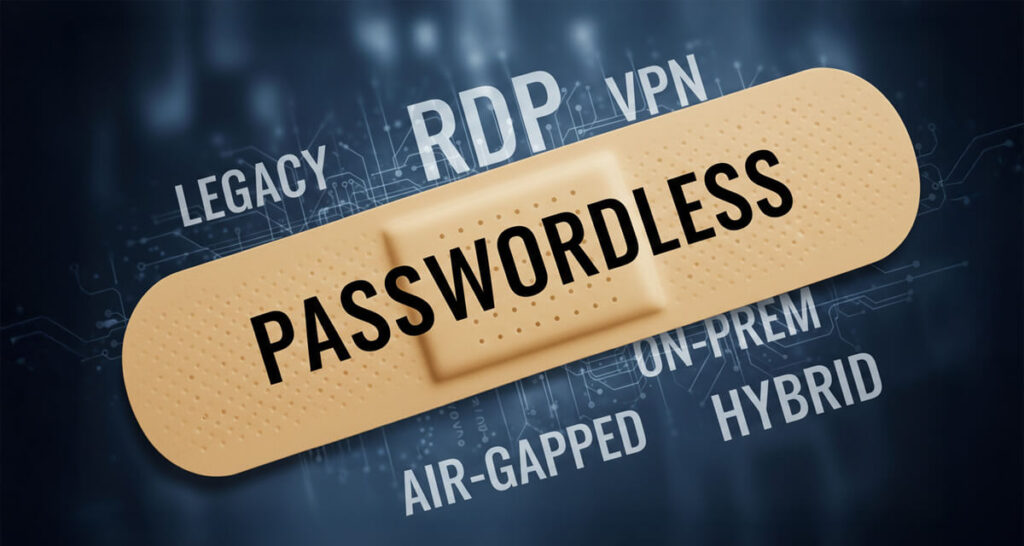
Passwordless authentication replaces user-managed passwords with cryptographic credentials bound to a device or a biometric. It works well on modern systems. Most organizations, though, run hybrid environments that still include legacy platforms, VPNs, and remote desktop sessions that cannot support modern protocols. Fallback credentials survive in those gaps, which is why protecting the session matters
Passwordless Isn’t Fully Here: Why Hybrid Environments Need Continuous Protection Read More »

CHANGE PUTS ALL YOUR CHOICES TO THE TEST HIPAA Security Rule Is Getting A Much-Needed Upgrade. So What? Updated 1 September 2026. This post was written when the HIPAA Security Rule update was newly proposed. It has still not been finalized, and the timeline has moved twice. HHS has placed the rulemaking under long-term actions,
The HIPAA Security Rule Update: What Changed, What Slipped, and How to Prepare Read More »

TL;DR A modern authentication platform does more than add a second factor at sign-in — it manages identity, access, and trust across users, devices, and applications throughout the session. The right platform balances strong authentication, RBAC-driven access control, integrations, and continuous verification, so organizations evaluating SSO alternatives should prioritize platforms with passwordless support, flexible RBAC,
Choosing the Right Authentication Platform for Your Organization Read More »

TL;DR Modern enterprise cybersecurity is no longer built around firewalls and network perimeters. It centers on verifying people continuously, not just once at sign-in, and reducing breach risk across distributed, hybrid workforces. Zero Trust principles, workforce-focused access controls, and adaptive authentication technology work together so protection extends through the entire session, not just the moment
Modern Cybersecurity for Enterprise: People, Process, and Technology Read More »