
Eric Paul

Woman using multi-factor authentication tools.

The Hidden Costs Traditional Authentication Tools Don’t Solve.

Authentication total cost of ownership is the full cost of running an authentication platform, including licensing, infrastructure, support, and lost user time. Most vendor TCO models count only the first two. The larger and less visible cost is friction: password resets, repeated prompts, enrollment, and account recovery. In most organizations, that friction, not infrastructure, is

The Hidden Costs Traditional Authentication Tools Don’t Solve. Read More »

User interacting with passwordless authentication technology.

Too Many Authenticators, Too Many Tickets: The Operational Burden of Traditional Passwordless

Authenticator sprawl is what happens when a workforce accumulates more authentication methods than it can manage: a phone app for one system, a security key for another, backup codes somewhere, and a password still sitting underneath as the fallback. Every method has to be enrolled, carried, replaced, and recovered. That lifecycle, not the sign-in itself,

Too Many Authenticators, Too Many Tickets: The Operational Burden of Traditional Passwordless Read More »

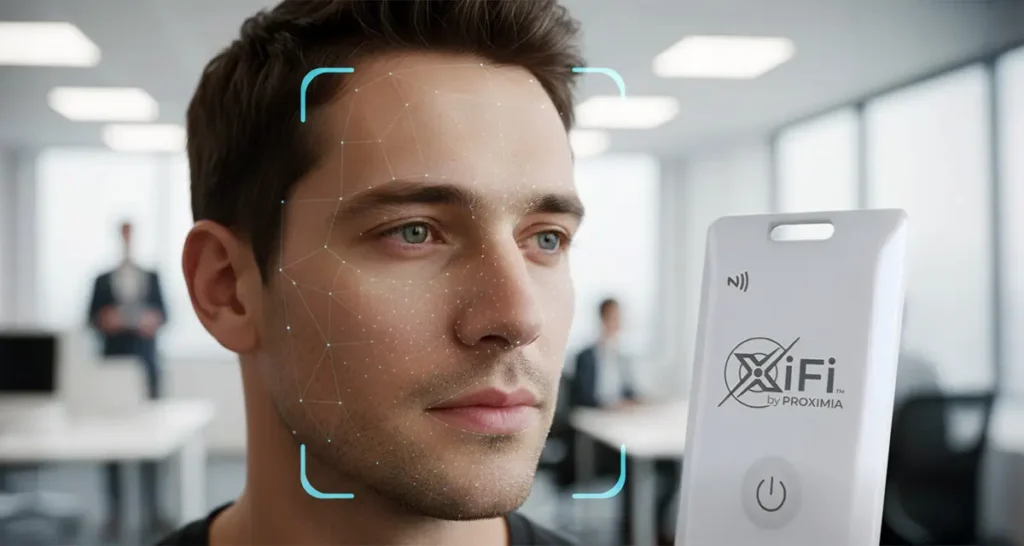
Biometric scan with XiFi card device.

Multi-Factor Authentication: 2026 Guide to Stronger Security

TL;DR Multi-Factor Authentication (MFA) requires two or more independent proofs of identity—something you know, have, or are—before granting access, closing the gap left by passwords alone. Traditional push- and code-based MFA still leaves users exposed to MFA fatigue and phishing proxies that intercept one-time codes. Proximia extends MFA with live biometrics and continuous, presence-based verification

Multi-Factor Authentication: 2026 Guide to Stronger Security Read More »

Person using biometric authentication at computer.

Passwordless Authentication: What It Is, Why It Matters, and How to Implement It

Passwordless authentication replaces passwords with FIDO2-based passkeys and biometrics, letting users sign in through something they are or have rather than something they must remember and protect. It removes stored credentials as an attack surface while aligning with frameworks such as NIST 800-63B. Paired with continuous, presence-based authentication, it verifies not just who signs in,

Passwordless Authentication: What It Is, Why It Matters, and How to Implement It Read More »

Medical Cybersecurity - 6 Challenges and How to Solve Them

Healthcare’s Top 6 Cybersecurity Challenges—And How to Solve Them

Healthcare organizations face six recurring cybersecurity challenges: ransomware, compliance risk, password fatigue, shared-workstation exposure, remote access, and legacy systems — and passwords sit at the center of most of them. Proximia replaces passwords with live biometrics and persistent proximity via the XiFi Card, closing the shared-workstation gap that passwordless authentication and a Zero Trust approach

Healthcare’s Top 6 Cybersecurity Challenges—And How to Solve Them Read More »

Healthcare Cybersecurity: Why Zero Trust Authentication is the Future

Healthcare Cybersecurity: Passwordless Zero Trust Authentication is the Future

Healthcare organizations face an evolving threat landscape that static passwords and one-time logins can no longer protect against. Zero Trust and passwordless authentication give hospitals and health systems a way to secure shared clinical workstations and remote access without slowing down patient care. Proximia replaces passwords with live biometrics and persistent proximity, keeping sessions protected

Healthcare Cybersecurity: Passwordless Zero Trust Authentication is the Future Read More »

Scroll to Top